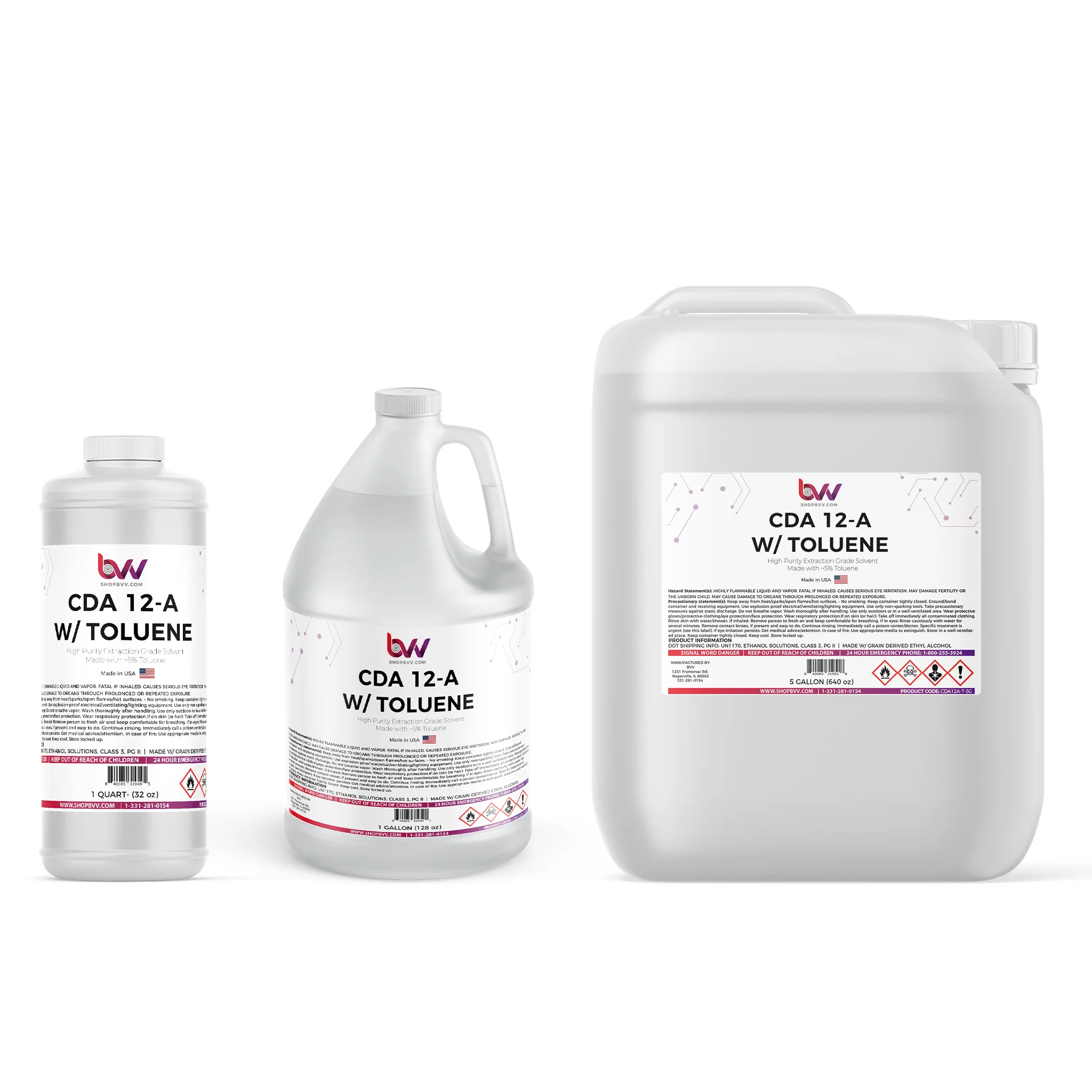
CDA 12A w/ Toluene High Purity Extraction Solvent
CDA 12A w/ Toluene
HAZMAT ITEMS ARE NON-REFUNDABLE. ALL SALES ARE FINAL
(Note: Container style and color may vary)
Disclaimer: Prices may vary due to market value and for orders of 4 totes or more and a tanker there could be up to a 2 week lead time. Call in for more accurate lead times.
Key Features:
-
Significantly Reduced Cost due to the absence of Federal Tax
-
Produces Exceptional Quality Extractions
-
Leaves No Residuals or Tastes
-
Evaporates Completely in a Rotary Evaporator
| Vapor Pressure: | 40.9mmHg at 20°C |
| UN Number | 1170 |
| Density: | 0.7905g/cm³ |
| Specific Gravity | 0.7905 |
| Flash Point: | 13.9°C (57°F) |
| Boiling Point: | 78.5°C (173°F) |
| Melting Point: | -90.0°C (-130°F) |
| Chemical Formula: |
Ethanol C2H6O Toluene C7H8 |
| CAS#(s) |
Ethanol 64-17-5 Toluene 108-88-3 |
| Molecular Weight: | 72.1057 |
| Appearance | Colorless Liquid |
| Odor: | Mint or acetone-like |
| Density | 0.7905g/cm³ |
| Boiling Point: | 78.5c/173.3F |
| Solubility in water: | Miscible |
| GHS Pictograms: |   |
| GHS Signal Word: | Danger |
| GHS Hazard Statements: | H225, H319 |
| GHS Precautionary Statements | P210, P233, P240, P241, P242, P243, P261, P264, P271, P280, P303+P361+P353, P304+P340, P305+P351+P338, P312, P337+P313, P370+P378, P403+P233, P403+P235, P405, P501 |
| UN Identification Number: | 1987 |
| Proper Shipping Name: | Alcohols |
| Transport Hazard Class: | 3 |
| Packing Group: | I |
| DOT Placard: | 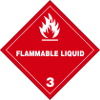 |
What is Denatured Ethanol?
Denatured ethanol, also known as denatured alcohol, is ethanol (ethyl alcohol) that has been rendered unfit for human consumption by the addition of denaturants. Denaturants are typically chemicals that make the ethanol taste bad or have toxic effects, and they are added to discourage people from drinking the substance.
Why is Ethanol Denatured?
What is denatured ethanol used for?
-
Industrial Solvent: Denatured ethanol is widely used as a solvent in industries such as pharmaceuticals, cosmetics, and manufacturing. It is effective in dissolving a variety of substances.
-
Cleaning Agent: Due to its solvent properties, denatured ethanol is used as a cleaning agent for surfaces, equipment, and machinery in industrial and commercial settings.
-
Fuel Additive: Denatured ethanol is sometimes used as a fuel additive, especially in the blending of gasoline. It can improve combustion efficiency and reduce emissions.
-
Paint and Coating Industry: It is used as a solvent in the formulation of paints, varnishes, and coatings.
-
Pharmaceuticals: Denatured ethanol is used in the pharmaceutical industry for various purposes, including the extraction of medicinal compounds.
-
Laboratory Use: In laboratories, denatured ethanol is often used for tasks like sterilization and as a solvent for experiments.
-
Inks and Dyes: It is employed in the production of inks and dyes due to its ability to dissolve pigments.
-
Adhesives and Sealants: Denatured ethanol is used in the formulation of adhesives and sealants.
-
Window Cleaning: It is used in commercial window cleaning solutions.
-
Automotive Industry: In the automotive industry, denatured ethanol is used for cleaning and degreasing.
What can be used to denature ethanol?
What does CDA mean?
Completely Denatured Alcohol (CDA) is a type of denatured alcohol that has been rendered unfit for human consumption by the addition of denaturing agents. Denatured alcohol is ethanol (ethyl alcohol) that has been intentionally adulterated to make it toxic, foul-tasting, or otherwise undrinkable. This denaturing process is done to exempt the alcohol from excise duty and other taxes, as it's not intended for use in beverages.
What is CDA 12A?
Can you remove Toluene from CDA 12A?
What is an Azeotrope?
An azeotrope is a mixture characterized by having identical concentrations in both its vapor and liquid phases. This stands in contrast to ideal solutions, where one component is usually more volatile than the other, allowing for separation through distillation. When an azeotrope forms, the concentrations in both phases remain the same, hindering separation through traditional distillation methods.
CDA 12A w/ Toluene
HAZMAT ITEMS ARE NON-REFUNDABLE. ALL SALES ARE FINAL
(Note: Container style and color may vary)
Disclaimer: Prices may vary due to market value and for orders of 4 totes or more and a tanker there could be up to a 2 week lead time. Call in for more accurate lead times.
Key Features:
-
Significantly Reduced Cost due to the absence of Federal Tax
-
Produces Exceptional Quality Extractions
-
Leaves No Residuals or Tastes
-
Evaporates Completely in a Rotary Evaporator
| Vapor Pressure: | 40.9mmHg at 20°C |
| UN Number | 1170 |
| Density: | 0.7905g/cm³ |
| Specific Gravity | 0.7905 |
| Flash Point: | 13.9°C (57°F) |
| Boiling Point: | 78.5°C (173°F) |
| Melting Point: | -90.0°C (-130°F) |
| Chemical Formula: |
Ethanol C2H6O Toluene C7H8 |
| CAS#(s) |
Ethanol 64-17-5 Toluene 108-88-3 |
| Molecular Weight: | 72.1057 |
| Appearance | Colorless Liquid |
| Odor: | Mint or acetone-like |
| Density | 0.7905g/cm³ |
| Boiling Point: | 78.5c/173.3F |
| Solubility in water: | Miscible |
| GHS Pictograms: | |
| GHS Signal Word: | Danger |
| GHS Hazard Statements: | H225, H319 |
| GHS Precautionary Statements | P210, P233, P240, P241, P242, P243, P261, P264, P271, P280, P303+P361+P353, P304+P340, P305+P351+P338, P312, P337+P313, P370+P378, P403+P233, P403+P235, P405, P501 |
| UN Identification Number: | 1987 |
| Proper Shipping Name: | Alcohols |
| Transport Hazard Class: | 3 |
| Packing Group: | I |
| DOT Placard: | |
What is Denatured Ethanol?
Denatured ethanol, also known as denatured alcohol, is ethanol (ethyl alcohol) that has been rendered unfit for human consumption by the addition of denaturants. Denaturants are typically chemicals that make the ethanol taste bad or have toxic effects, and they are added to discourage people from drinking the substance.
Why is Ethanol Denatured?
What is denatured ethanol used for?
-
Industrial Solvent: Denatured ethanol is widely used as a solvent in industries such as pharmaceuticals, cosmetics, and manufacturing. It is effective in dissolving a variety of substances.
-
Cleaning Agent: Due to its solvent properties, denatured ethanol is used as a cleaning agent for surfaces, equipment, and machinery in industrial and commercial settings.
-
Fuel Additive: Denatured ethanol is sometimes used as a fuel additive, especially in the blending of gasoline. It can improve combustion efficiency and reduce emissions.
-
Paint and Coating Industry: It is used as a solvent in the formulation of paints, varnishes, and coatings.
-
Pharmaceuticals: Denatured ethanol is used in the pharmaceutical industry for various purposes, including the extraction of medicinal compounds.
-
Laboratory Use: In laboratories, denatured ethanol is often used for tasks like sterilization and as a solvent for experiments.
-
Inks and Dyes: It is employed in the production of inks and dyes due to its ability to dissolve pigments.
-
Adhesives and Sealants: Denatured ethanol is used in the formulation of adhesives and sealants.
-
Window Cleaning: It is used in commercial window cleaning solutions.
-
Automotive Industry: In the automotive industry, denatured ethanol is used for cleaning and degreasing.
What can be used to denature ethanol?
What does CDA mean?
Completely Denatured Alcohol (CDA) is a type of denatured alcohol that has been rendered unfit for human consumption by the addition of denaturing agents. Denatured alcohol is ethanol (ethyl alcohol) that has been intentionally adulterated to make it toxic, foul-tasting, or otherwise undrinkable. This denaturing process is done to exempt the alcohol from excise duty and other taxes, as it's not intended for use in beverages.
What is CDA 12A?
Can you remove Toluene from CDA 12A?
What is an Azeotrope?
An azeotrope is a mixture characterized by having identical concentrations in both its vapor and liquid phases. This stands in contrast to ideal solutions, where one component is usually more volatile than the other, allowing for separation through distillation. When an azeotrope forms, the concentrations in both phases remain the same, hindering separation through traditional distillation methods.
Original: $10.00
-65%$10.00
$3.50Description
CDA 12A w/ Toluene
HAZMAT ITEMS ARE NON-REFUNDABLE. ALL SALES ARE FINAL
(Note: Container style and color may vary)
Disclaimer: Prices may vary due to market value and for orders of 4 totes or more and a tanker there could be up to a 2 week lead time. Call in for more accurate lead times.
Key Features:
-
Significantly Reduced Cost due to the absence of Federal Tax
-
Produces Exceptional Quality Extractions
-
Leaves No Residuals or Tastes
-
Evaporates Completely in a Rotary Evaporator
| Vapor Pressure: | 40.9mmHg at 20°C |
| UN Number | 1170 |
| Density: | 0.7905g/cm³ |
| Specific Gravity | 0.7905 |
| Flash Point: | 13.9°C (57°F) |
| Boiling Point: | 78.5°C (173°F) |
| Melting Point: | -90.0°C (-130°F) |
| Chemical Formula: |
Ethanol C2H6O Toluene C7H8 |
| CAS#(s) |
Ethanol 64-17-5 Toluene 108-88-3 |
| Molecular Weight: | 72.1057 |
| Appearance | Colorless Liquid |
| Odor: | Mint or acetone-like |
| Density | 0.7905g/cm³ |
| Boiling Point: | 78.5c/173.3F |
| Solubility in water: | Miscible |
| GHS Pictograms: | |
| GHS Signal Word: | Danger |
| GHS Hazard Statements: | H225, H319 |
| GHS Precautionary Statements | P210, P233, P240, P241, P242, P243, P261, P264, P271, P280, P303+P361+P353, P304+P340, P305+P351+P338, P312, P337+P313, P370+P378, P403+P233, P403+P235, P405, P501 |
| UN Identification Number: | 1987 |
| Proper Shipping Name: | Alcohols |
| Transport Hazard Class: | 3 |
| Packing Group: | I |
| DOT Placard: | |
What is Denatured Ethanol?
Denatured ethanol, also known as denatured alcohol, is ethanol (ethyl alcohol) that has been rendered unfit for human consumption by the addition of denaturants. Denaturants are typically chemicals that make the ethanol taste bad or have toxic effects, and they are added to discourage people from drinking the substance.
Why is Ethanol Denatured?
What is denatured ethanol used for?
-
Industrial Solvent: Denatured ethanol is widely used as a solvent in industries such as pharmaceuticals, cosmetics, and manufacturing. It is effective in dissolving a variety of substances.
-
Cleaning Agent: Due to its solvent properties, denatured ethanol is used as a cleaning agent for surfaces, equipment, and machinery in industrial and commercial settings.
-
Fuel Additive: Denatured ethanol is sometimes used as a fuel additive, especially in the blending of gasoline. It can improve combustion efficiency and reduce emissions.
-
Paint and Coating Industry: It is used as a solvent in the formulation of paints, varnishes, and coatings.
-
Pharmaceuticals: Denatured ethanol is used in the pharmaceutical industry for various purposes, including the extraction of medicinal compounds.
-
Laboratory Use: In laboratories, denatured ethanol is often used for tasks like sterilization and as a solvent for experiments.
-
Inks and Dyes: It is employed in the production of inks and dyes due to its ability to dissolve pigments.
-
Adhesives and Sealants: Denatured ethanol is used in the formulation of adhesives and sealants.
-
Window Cleaning: It is used in commercial window cleaning solutions.
-
Automotive Industry: In the automotive industry, denatured ethanol is used for cleaning and degreasing.
What can be used to denature ethanol?
What does CDA mean?
Completely Denatured Alcohol (CDA) is a type of denatured alcohol that has been rendered unfit for human consumption by the addition of denaturing agents. Denatured alcohol is ethanol (ethyl alcohol) that has been intentionally adulterated to make it toxic, foul-tasting, or otherwise undrinkable. This denaturing process is done to exempt the alcohol from excise duty and other taxes, as it's not intended for use in beverages.
What is CDA 12A?
Can you remove Toluene from CDA 12A?
What is an Azeotrope?
An azeotrope is a mixture characterized by having identical concentrations in both its vapor and liquid phases. This stands in contrast to ideal solutions, where one component is usually more volatile than the other, allowing for separation through distillation. When an azeotrope forms, the concentrations in both phases remain the same, hindering separation through traditional distillation methods.